Bundt, Bundt, Bundt…NOOOOO!!
Shades of “Consumption Anarchy”
Except for a vague memory that the name of the brand Nothing Bundt Cakes was clever, I had never given another thought about the specialty baker. It wasn’t until a few months ago when a neighbor gifted some leftovers from a corporate event that I first sampled the product. The verdict? I thought it was good. But…sugar is poison and I have enough bad diet habits!
For some time I have been tweaking a concept for a charitable product fundraising platform. The idea includes food. But unlike familiar national campaigns involving a single product produced industrially (“those” cookies anyone?), the intent is for the products to be produced locally and to be of substantial quality. And also to be available twelve months a year. Ideally, the concept will partner with career tech programs and also create opportunities for special needs students and vulnerable adults. So, the following screenshotted story in the March 26 edition of the Wall Street Journal caught my eye. Clearly, KKR is a private equity behemoth. And KKR is set to buy Nothing Bundt Cakes from another private equity firm in a deal valued at more than $2 billion.
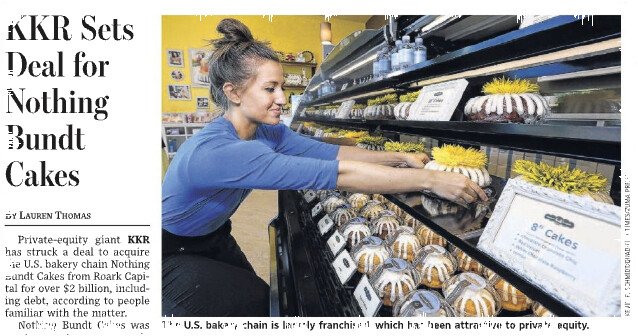
Something I didn’t know until I did a little investigation was that Nothing Bundt Cakes has a very well organized program offering their products to local nonprofits for use in fundraising. On the surface, that should sound like a great idea. Especially for someone interested in creating a product fundraising platform, right? Not so fast!
Something else that I discovered was that Nothing Bundt Cakes is a machine for extracting money from communities. And it is the powerfully soft-sell of “celebratory events” that drives the value being extracted. Of course, restaurant industry news stories don’t describe financial performance in those terms. But all one has to do is understand who gets what. According to Nations Restaurant News “profit per store” runs about $350,000.
One category of cash flows that results in extraction is the obvious; that is, royalties, franchise fees, pooled marketing fees and franchisee profits (if the owner of the franchise is not local). Ok, perhaps the amount of extraction for any one community is not too horrendous. Let’s say at least $250,000 per year? Frequently more? Then consider all of the other local brands that are built the same way. It adds up!
Less obvious is the effect that a “cherrypicking premium bakery” with ownership outside of the community might have on the viability of more generalized local bakeries. If prospective bundt cake customers all get sucked into the local Nothing Bundt Cakes franchise location then a locally owned operation is that much worse off. Since I have grandkids living in Germany and visit often, I am convinced that most of us Americans live in a bread desert. Many people have no idea what they are missing! Of course, German Bakeries sell products like bundt cakes that would truly fit the Nothing Bundt Cake mission, but those items are a fraction of sales and a fraction of the selections of artisanal baked goods available (and amazingly inexpensive). Photo below is from a bakery in the town where my family resides, Freiburg im Breisgau.
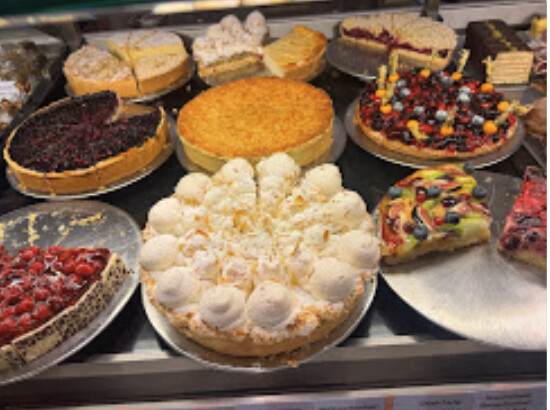
While it would be a very difficult case to make that the existence of Nothing Bundt Cakes alone means that I can’t easily and cost effectively get good quality German Brötchen any morning I want, it does illustrate a problem that, when combined with similar lost opportunities, could make just that case. And it could also mean that numerous opportunities for locals to lead better lives are being wasted because of…”consumption anarchy.”
Consumption anarchy?
The term sounds like something the Joker might come up with in The Dark Knight!

It is actually fairly simply. It is the condition when we consumers who all share very similar interests as consumers simply fail to have a meeting on a particular product/service we all are buying and resolve to hire a store manager. As a result, we all act completely independently with our decision to buy without any coordination. Buying is “consumption.” Acting without coordination is “anarchy.” Ergo, Consumption Anarchy.
A savvy reader of this post might ask the question, “what about the money it takes to open the store and pay the manager?” The answer is, without going into great detail, “it ain’t hard” in this modern economy. The proof of this just might best be illustrated in the actual Nothing Bundt Cakes franchise business model. Apparently, a significant majority of the Nothing Bundt Cakes franchisees are individual women. If an individual woman can orchestrate becoming a franchisee for Nothing Bundt Cakes, then a community of women (and not just women, of course) with a demand for bundt cakes (and other types of baked goods for celebratory events and general consumption) can easily swing it.
Oh, and I’m incubating a fund for that purpose on behalf of a charity. This isn’t just “tawk.”
Also posted on my Substack page HERE. Free to subscribe. All these efforts are targeted to start in NE Ohio.